

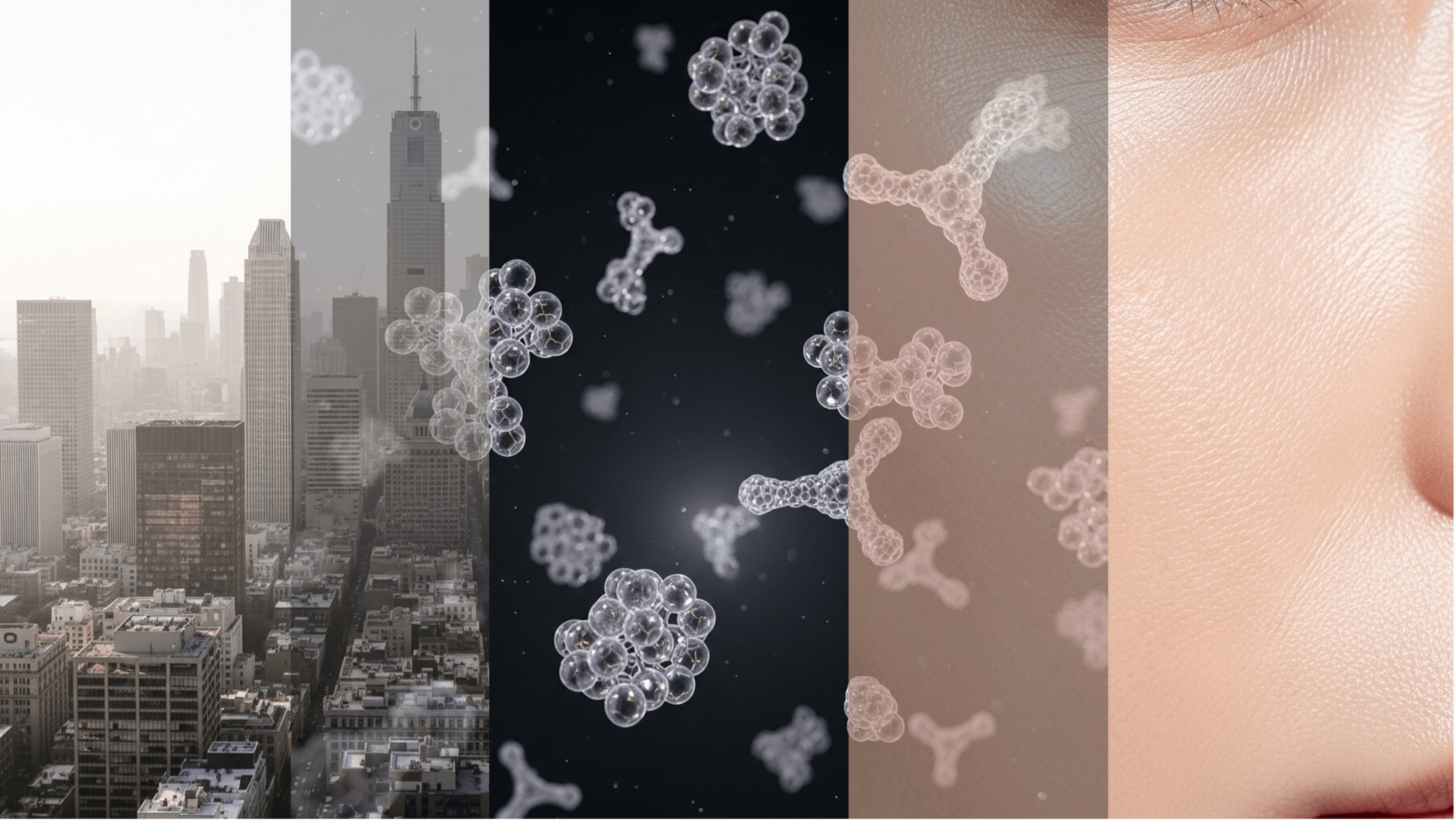
Urbanization, intensive industrial activity, and increasing environmental stressors have reshaped the priorities of modern skincare science. Today, one of the most urgent challenges for formulators and researchers concerns the ability of cosmetic products to protect the skin from airborne pollutants. As particulate matter (PM), volatile organic compounds (VOCs), heavy metals and combustion residues continue to accumulate in urban environments, the skin becomes the first, and often most vulnerable, target of their biological effects.
Consumers are increasingly aware of pollution-related aging and irritation, and demand solutions that truly work. Yet, despite the abundance of anti-pollution claims, only a minority of products are supported by standardized, physiologically relevant test data. It is in this scientific gap that React4life’s MIVO® technology (Multi-In-Vitro Organ) emerges as a decisive innovation, offering robust and reproducible evidence for the performance of anti-pollution skincare formulations.
Pollution and Skin Health: A Scientific and Commercial Priority
Airborne pollutants can adhere to the skin surface, penetrate the epidermal barrier, and trigger oxidative stress, inflammatory pathways, lipid imbalance and structural degradation of key molecules such as collagen and elastin. Research increasingly associates pollution exposure with skin dullness, dryness, barrier breakdown, increased acne tendency, pigmentation disorders and accelerated extrinsic aging.
Short-term exposure is often characterized by barrier dysfunction, irritation, accumulation of toxins and metabolic imbalance. With longer exposure, the consequences become more visible and more persistent: dermal matrix degradation, wrinkle formation, uneven tone, and loss of firmness. The common pathogenic denominator is oxidative stress and the excessive formation of free radicals, an effect well documented in dermatological literature.
This scientific knowledge aligns closely with market dynamics. As consumer awareness rises, brands are racing to launch detoxifying, protective and rebalancing formulas. However, for companies, the real differentiator is no longer the marketing message—it is the ability to provide solid experimental proof of protective efficacy.
Although numerous in vitro strategies have been explored for evaluating anti-pollution performance, the field lacks universally accepted benchmarks. Different pollutants alter different biomarkers, from skin pH and lipid composition to cellular oxidative stress and DNA integrity, making comparisons across studies extremely difficult.
Consequently, one of the most direct and scientifically sound approaches for evaluating anti-pollution skincare is to measure whether pollutants can cross the skin barrier—and to what extent a product prevents this process. Such data provide a clear, quantitative and reproducible indication of protective efficacy, avoiding the noise often associated with complex molecular readouts.
MIVO®: A Next-Generation Platform for Realistic Anti-Pollution Evaluation
The MIVO® fluidic bioreactor developed by React4life represents a transformative step forward in testing anti-pollution skincare. Unlike conventional static systems, MIVO® enables continuous perfusion and nutrient supply, creating a dynamic environment that more closely resembles human physiology.
The device can host human cell monolayers as well as reconstructed 3D epidermal tissues, and skin biopsies, maintaining tissue viability and barrier function in conditions that simulate those found in vivo. This realism is critical for generating actionable data and ensuring that results translate meaningfully to real-world skin physiology.
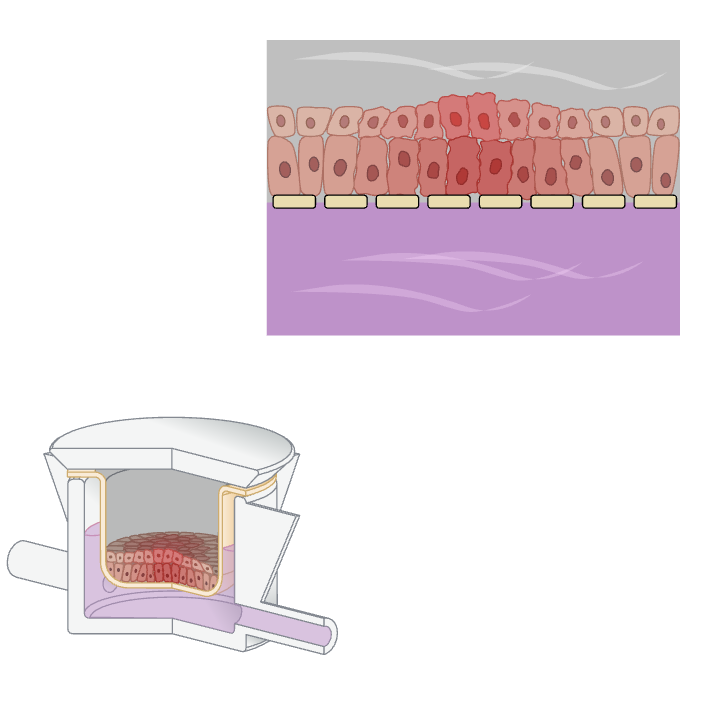
React4life’s patented method exposes realistic skin models to certified atmospheric-mimicking particulate matter and measures:
- the amount that penetrates the skin barrier
- the fraction absorbed by the tissue
- the portion that remains externally trapped
By comparing treated and untreated models, MIVO® enables the calculation of a protection index, directly reflecting a product’s ability to prevent the passage of pollutants.
This approach is fast, reproducible and highly sensitive, even for extremely fine particulate matter, which represents the most biologically reactive and dangerous fraction of pollution. As a result, it empowers formulators, R&D teams and regulatory offices with clear, objective and defendable evidence for anti-pollution claims.
Supporting Cosmetic Innovation and Claim Substantiation
In a marketplace increasingly regulated by scientific rigor and consumer scrutiny, the cosmetic industry is entering an era where efficacy must be proven, not merely promised. Technologies like MIVO® represent a strategic advantage, combining physiological realism with measurable outcomes and allowing research teams to move beyond traditional, inconsistent testing practices.
The ability to demonstrate real, quantified protection against pollution strengthens brand positioning, accelerates development cycles, and builds credibility with scientific and consumer audiences alike.
In other words, MIVO® bridges the gap between biological relevance and commercial applicability, giving innovation-driven beauty companies the means to validate high-value claims and differentiate themselves in a competitive, premium segment.