

A human pharmacomicrobiomics model: Multi-organ Microbiota-gut-on-cancer-on-chip reveals barrier-driven modulation of chemotherapy efficacy and toxicity
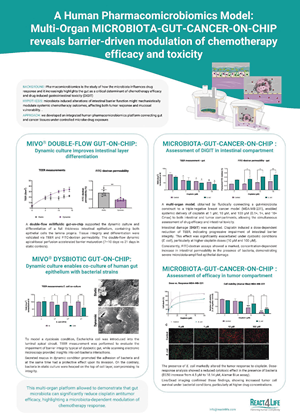
MIVO® We used our MIVO organ on chip to develop an integrated multi-organ platform where we connected a gut tissue with cancer tissue.
MIVO allow the culture of 3D tissues under a dynamic flow, which mimic the bloodstream.
The gut compartment was developed based on a double flow gut-on-chip, which has two independent flows: one in the apical side which mimic the intestinal lumen and one in the basal side which mimic the blood. This particular environment accelerates the intestinal tissue maturation, achieving full differentiation in 7-10 days, compared to 21 days of static culture.
Escherichia coli was applied on the apical side of the gut compartment, to model a dysbiotic condition. The dynamic environment allows a stable and balanced co-culture of intestinal cells and bacteria, preventing their overgrowth.
This gut compartment was fluidically connected to a 3D model of breast cancer.
Cisplatin was administered to both tissues, through the shared basal circulation, mimicking the intravenous systemic administration.
We evaluated both the drug toxicity on gut and the drug efficacy on cancer. Interestingly, cisplatin showed lower anti-cancer efficacy in the dysbiotic gut, where Escherichia coli was present.
This work is a proof of concept, but allows to understand the pharmacomicrobiomics and study how the microbiota can interact with drugs, modulating the response.
-
-
- Conference: Probiota 2026, Dublin
- Authors: E. Palamà1, M. Aiello1,2, S. Scaglione1,2
-
1React4life, Genoa (Italy)
2National Research Council (CNR Italy)
Fill the form below to get your copy
Check your email! You will receive soon a message from us with the copy requested.
Other Posters
All Resources
Never stop learning!
Check publications from the team, protocols, and useful information to boost your research and get into organ on chip technology!